
Why Music Students Should Participate in Performances
Taking music lessons is a rewarding journey of self-expression, skill development, and personal growth. Students learn notes, rhythm, technique, and practice habits — but one of the biggest turning points in a student’s musical development doesn’t happen in the practice room.
It happens on a stage.
Whether it’s a relaxed studio recital, a school event, or a community performance, performing is not an “extra.” It’s actually a core part of becoming a musician. The moment a student prepares to share their music with others, something changes. Practice becomes more intentional, focus sharpens, and their connection to music deepens in a way that lessons alone simply can’t replicate.
Here’s why every music student — beginner through advanced — benefits from participating in performances.
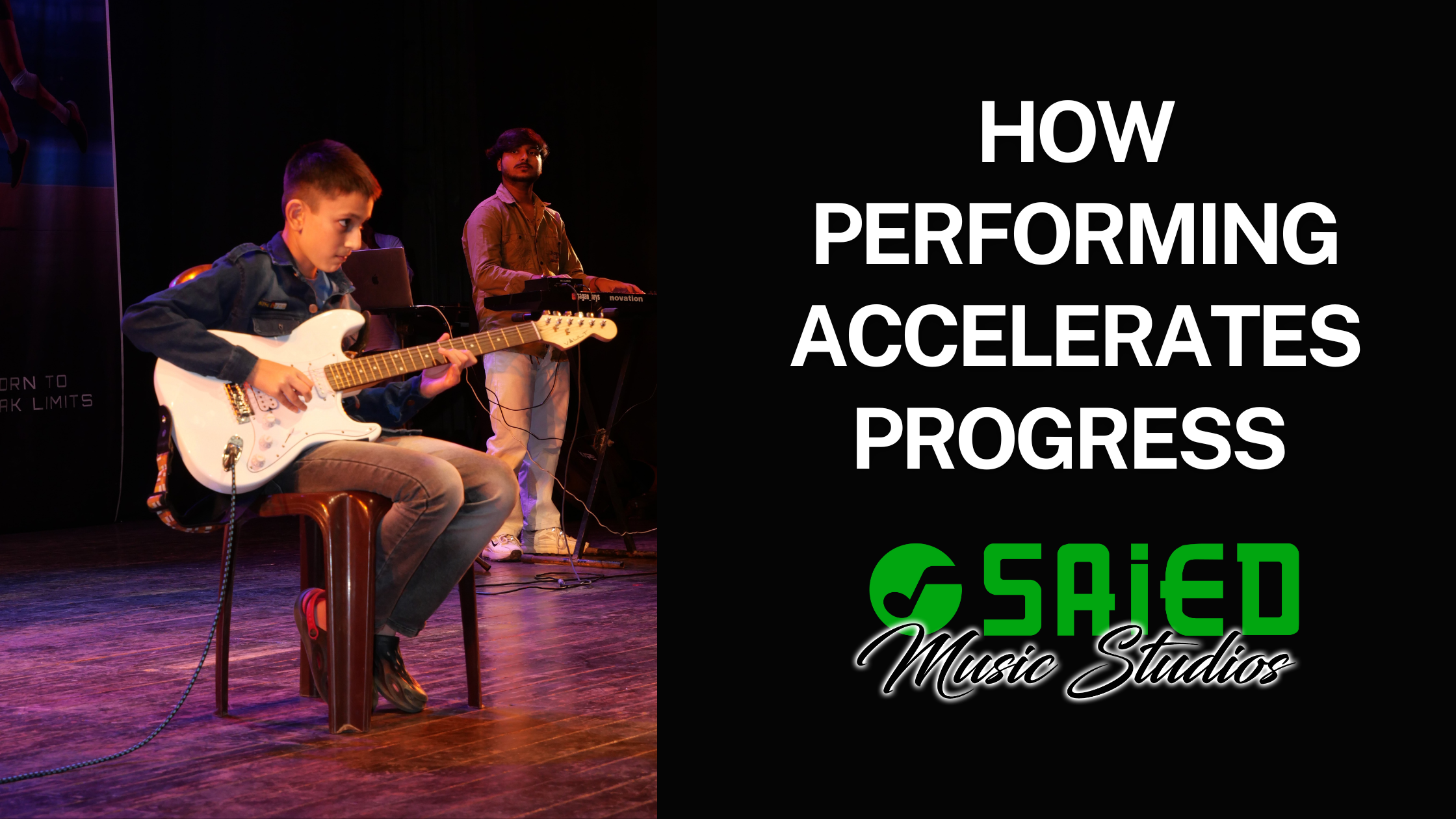
1. Builds Confidence and Resilience
Performing takes courage. Even the most outgoing students feel a few butterflies before they begin — and that’s a good thing. Learning to manage nervousness is a skill that develops through experience.
When students perform, they practice:
Staying calm under pressure
Focusing despite distractions
Continuing even after a small mistake
Finishing what they started
The important part is this: students quickly discover that nerves are temporary. The anticipation is usually scarier than the performance itself.
After they finish, something powerful happens — relief turns into pride.
Each performance teaches them:
“I was nervous… and I still did it.”
That lesson carries into school presentations, sports, auditions, job interviews, and public speaking. Music performances quietly build emotional resilience and self-trust that students will use for the rest of their lives.
2. Gives Practice a Purpose
One of the biggest challenges music students face is motivation. Without a goal, practice can feel repetitive. Students may play through songs casually but never fully refine them.
A performance changes everything.
Now there is:
A real date
A real audience
A real reason to prepare
Instead of simply “playing the piece,” students begin to work on the piece. They start noticing details — dynamics, rhythm accuracy, articulation, posture, tone, and memorization. Their listening improves, and their teacher can coach at a much deeper level.
Students often make weeks or even months of progress during the preparation period leading up to a recital.
In other words:
Performances don’t interrupt learning — they accelerate it.
3. Creates a Sense of Accomplishment
Music is unique because progress is gradual. Students may not always notice how much they’ve improved week-to-week. A performance acts like a milestone marker in their musical journey.
It gives them a moment where they can clearly say:
“I learned this. I prepared this. I completed this.”
The applause matters — not because of recognition, but because it validates effort. Students begin to associate hard work with a positive outcome. That connection builds intrinsic motivation.
After a performance, many students practice more willingly. Why? Because music stops feeling like an assignment and starts feeling like an achievement.
This is often the moment a child begins to identify themselves differently:
Not just someone who takes lessons…
but someone who is a musician.
4. Teaches Focus and Accountability
During lessons, teachers guide students through corrections and restarts. On stage, however, there is no pausing and no starting over. Students must keep going.
This teaches:
Preparation responsibility
Mental concentration
Problem-solving in real time
If they lose their place, they learn how to recover. If a note goes wrong, they learn to continue confidently.
These experiences are incredibly healthy for developing a growth mindset. Students learn that mistakes are normal — and survivable. In fact, many students come off stage smiling after realizing the world didn’t end when something went imperfectly.
Performances help replace fear of mistakes with confidence in recovery.
5. Builds Musicality and Expression
In lessons, students learn how to play music.
In performances, they learn how to communicate music.
The presence of an audience changes how students think about their playing. They begin to consider:
Dynamics (soft vs loud)
Emotional expression
Musical phrasing
Tone quality
Character of the piece
They stop just pressing keys, bowing strings, or strumming chords — and start telling a story.
This is where artistry begins.
Students often play more musically in their recital piece than anything else they’ve ever learned because they are no longer playing only for a teacher — they’re sharing with listeners.
6. Strengthens Motivation to Continue Lessons
Many students go through phases where they question why they are taking lessons at all. A performance gives them an answer.
They experience:
Pride from family support
Encouragement from teachers
Inspiration from hearing other students
Excitement from accomplishment
Seeing slightly older or more advanced students perform is especially powerful. Younger students begin imagining what they might play one day. It gives them a vision for their future in music.
Quite often, students who perform regularly stay in lessons significantly longer than those who never do — because they see tangible results.
7. Creates Community
Music lessons can feel individual — one student, one teacher, one room. Performances connect students to something bigger.
They realize:
Other students are learning too
Everyone feels nervous
Everyone is improving at different speeds
Students encourage each other, families celebrate together, and teachers get to share in the progress. Recitals become less about perfection and more about participation.
For many students, performances become their favorite part of lessons.

Performing music is not about being perfect. It’s about being brave.
It’s about taking something you’ve worked on privately and sharing it publicly. It builds confidence, accelerates learning, strengthens motivation, and helps students discover the real joy of making music.
Every recital — first or tenth — marks growth.
Students don’t need to be advanced. They don’t need to be flawless. They just need to be willing.
Because the stage isn’t where students prove they’re ready.
The stage is what helps them become ready.
If your student has been considering it, this is the perfect opportunity to take that step. Our Saied Music Studios performances are designed to be encouraging, supportive, and pressure-free — a positive first stage experience where students can feel proud of their progress and excited about what comes next.
Our yearly Spring and Winter Recital spots are limited, so be sure to register and give them a musical milestone they’ll always remember.
Saied Music Studios: 918.252.5542